Rainforest Chica HP Ojon Hair Bar April 12 2022, 0 Comments
I have many customers who ask me every year to make more of my HP Ojon Hair Soap Bar. This is a true soap, not a solid shampoo.
So I decided to share both the recipe and my process.
If you're a beginner, do your research first. If you have questions, feel free to contact me before you get started.
If you're a business and decide to sell it, go ahead! I only ask that you send a little good energy my way every time you sell a bar. 😊
This recipe yields approximately 2 lb. of finished soap after cooking.
Text or WhatsApp Chica: 954-274-2032
THE EQUIPMENT
-
A reasonably accurate digital scale. In soap making, everything is measured by weight, including liquids.
-
A food thermometer.
-
Heat-safe containers and spoons.
-
A crockpot.
-
A stick blender.
-
A loaf mold. A milk or juice carton works well—simply turn it on its side and cut away one panel. No liner is needed. Since this recipe produces a thick batter, loaf molds work much better than individual cavity molds.
-
Appropriate safety gear: gloves, safety glasses, a mask, and an apron.
THE INGREDIENTS
-
Sodium Hydroxide (Lye) – 3.11 oz.
-
Distilled Water – 8.36 oz.
-
Babassu Oil – 2 oz.
-
Brazil Nut Oil – 4 oz.
-
Cupuaçu Butter – 8 oz.
-
Murumuru Butter – 2 oz.
-
Andiroba Oil – 4 oz.
-
Castor Oil – 2 oz. (Castor oil has a unique fatty acid profile that contributes excellent lather and conditioning. It's also easy to find in most pharmacies.)
-
Ojon Oil – 1 to 1.5 oz.
-
Fragrance or essential oil (optional) – 0.5 to 1 oz., depending on the fragrance. I personally prefer this soap unscented, but if you decide to fragrance it, I recommend adding it after the Ojon oil. Be sure to research the fragrance or essential oil you choose, as some can accelerate trace or change the appearance of the finished soap.

I am going to show you my process. If you are new to soap making, I recommend doing a little more research first. If you are an experienced soap maker, you probably already have your own style.
Keep in mind that I am not a professional soap maker. I simply found a method that works well for my own recipes.
1. Weigh every ingredient separately before you begin. You don't want to stop and weigh ingredients once the oils and lye have been mixed.
2. Mix the lye and water. Always add lye to water, never water to lye. Work in a well-ventilated area and wear appropriate safety gear. Use a heat-safe container, as the mixture can reach temperatures of around 200°F (93°C). The mixture will appear cloudy at first and then become clear after a few minutes.
3. Melt the butters in the crockpot. Once they are melted, add the remaining oils, except the Ojon oil, and allow everything to warm together for a few minutes before turning the crockpot off.
4. Keep an eye on the temperature of both the lye solution and the oils. I don't mix them above 100°F (38°C) because the batter can become too hot during the cook and may volcano. Trust me, it isn't fun.
5. Once both mixtures reach the desired temperature, pour the lye solution into the oils and stick blend until you reach trace. This recipe reaches trace fairly quickly. Trace is when the batter becomes thicker and has a smooth, pudding-like consistency.
At this point I put the lid on the crockpot and leave the soap alone. I only stir if it looks like it may rise too much or needs a little help. During the cook the soap will go through several stages and, after about 60 to 90 minutes, it will reach what many people describe as the "Vaseline stage." Mine usually looks glossy.
6. Once the soap has reached the glossy Vaseline stage and appears fully cooked, transfer it to another container. If it stays in the crockpot too long it can dry out, making it harder to mix.
7. Add the Ojon oil and stir vigorously until fully incorporated. Then add your fragrance or essential oil and mix again. Spoon the soap into the mold as soon as everything is well combined, as the batter will continue to firm up if you wait too long.
8. I like to place my mold in the refrigerator for a couple of hours before moving it to a cool, dry place. My soaps are usually ready to unmold and cut within 6 to 12 hours.
This is what my bar looks after cutting.


Photo 1 – What trace looks like. Please note: this is a different recipe that contains buriti oil. Your basic Ojon recipe will remain cream-colored until the Ojon oil is added after the cook.
Photo 2 – Saponification has begun. At this point I don't stir the soap. For small batches, the process takes care of itself. I only stir if it looks like the soap is rising too much or something isn't going as planned.
Photo 3 – The soap is fully saponified. I transferred it to another container and mixed in my post-cook superfat.
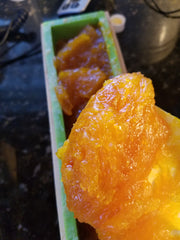
This is what your mix will look like after mixing the Ojon Oil, you will need to spoon it into the molds. The color will be like this or lighter depending on my batch of Ojon.
Make sure you're prepared and have done your research before getting started. If you have questions, ask me before making the mistakes! 😄
Good luck